


Rolex Arts Weekend: Desire floats art sponsor’s boat
You’re an artist and you’re just beginning to gain recognition. What you most desire is time to create, and access to a mentor who can help you make an international career breakthrough. Along comes Rolex. An international luxury brand with an impeccable reputation for excellence, and offers you exactly what you could barely dream of wishing for: time, resources, a mentor, and no expectations other than wearing your Rolex watch and standing at a lectern to thank them.
This is exactly what Rolex, through their Mentor & Protégé programme, have been offering artists across a variety of disciplines since 2002.
Imagine being a film maker mentored by Martin Scorsese, as was Celina Murga in 2008 and 2009. Or a musician and working with Youssou N’Dour, as Aurelio Martinez did in that cycle. Or ending up co-writing a zombie novella online for Wattpad with Margaret Atwood, as protégé Naomi Alderma did in 2012 and 2013. And so it goes, including visual art, dance, architecture, and theatre – a discipline in which Baxter CEO Lara Foot was mentored by the late Sir Peter Hall after being selected to participate in the second round of mentorships during 2004 and 2005.
It was during this period Foot staged the gut-wrenching Tshepang, during which a performer has had to step into the audience to comfort a weeping boy.
To be nominated, and then to be ushered into, the Mentor & Protégé programme is an opportunity that seems too incredible to exist for any artist. It’s like winning the Lotto.
The filmed interviews with all 54 mentors and protégés, which were screened continuously in the Baxter’s Golden Arrow Studio during this past weekend when the Rolex Mentor & Protégé 2018/19 cycle came to wind up in Cape Town, revealed the beauty of minds meeting and creativity manifesting in a sweep of staggering work. All seemingly effortlessly buoyed by the generosity of the mentors and the Geneva-based resources ticking in the background.
The lavish shindig at the end of each cycle and the announcement of the next, has taken place eight times in cities around the world before coming to the Baxter Theater centre for the ninth. Over 100 people, including past protégés and a bevy of media, were flown in from other countries to join the scores of locals who were hosted at exclusive events and invited to be privy to unique conversations.
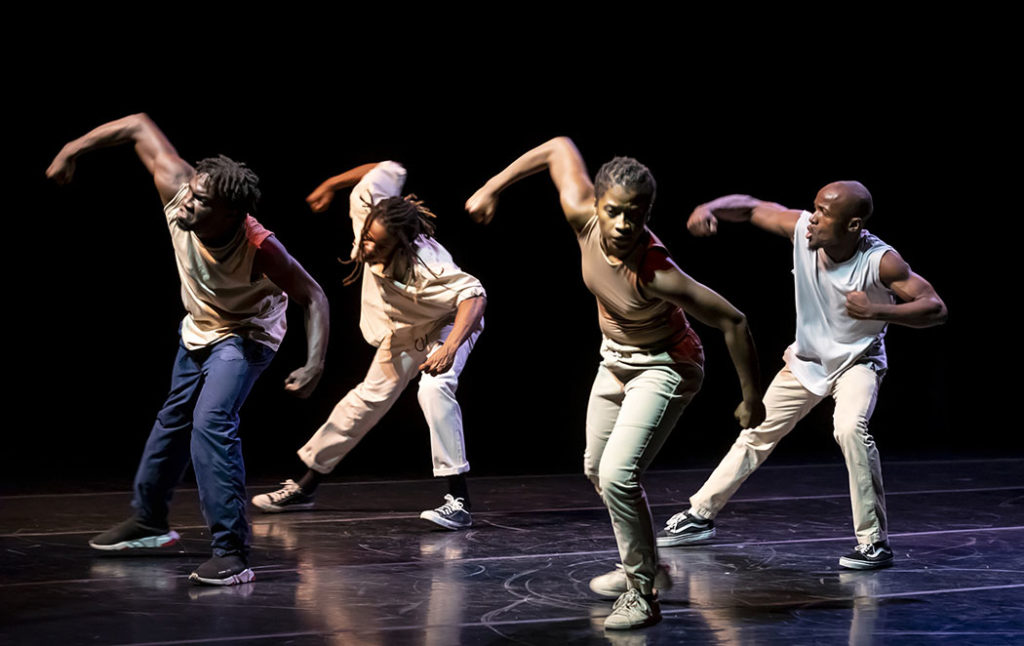
On Saturday there was the world premier of When the Night Comes by Khoudia Touré, a Senegalese hip-hop dancer who was mentored by choreographer Crystal Pite. Touré, together with dancers from the company she pioneered, Compagnie La Mer Noir, staged a darkly thrilling work that drew tears from the chest as its fierce movement grabbed us by the lapels with restrained violence.
Then there was a discussion between architect Mariam Kamara and her mentor, Africa’s most famous architect, Sir David Adjaye, on a cultural centre for the public in Niger that Kamara has designed.
Prior to these, in the morning was a conversation between Lara Foot, filmmaker Annemarie Jacir, musician Yo-Yo Ma, and Wole Soyinka, moderated by Professor Homi K Bhabha. It was, for the most part, unfortunate. The one misstep by the corporate sponsor whose presence was largely understated. It’s bad form to talk about the money.
But bringing tennis superstar Roger Federer onto stage three quarters of the way through a fascinating conversation about polarization conducted by the finest intellectual minds was a rather nouveau riche move.

To explain this, we need to backtrack a day.
The Rolex Arts Weekend was preceded by the Match in Africa between Federer and Rafael Nadal at the Cape Town Stadium, for which Rolex was also a sponsor. That they managed to combine the star-studded fund-raising tennis match (Bill Gates and Trevor Noah also took to the court) with the Mentor & Protégé weekend is testimony to the watchmaking brand’s clout.
This was the most exciting thing to happen for tennis in Africa in, like, forever, and a world-record breaking 51 954 people attended. International and some local media, and special guests received tickets (worth R1 950 each) and were feted with a plethora of food and champagne at a luxe marque before and after the match.
Federer is a Rolex ambassador. Yet despite the international airtime provided by the Friday night match, it was decided to also usher him onto the Baxter stage on Saturday morning, seemingly just to ensure the few hundred people in attendance also got the message (just in case they were unaware of the #matchinafrica).
It brought what had been a fascinating conversation – although one not without its own problems – to a dead halt. The converse would be the quality of tennis displayed if you were to walk Wole Soyinka onto Wimbledon to serve in the middle of a Federer/Nadal final. This is not to take away from Federer, but his expertise is not the pursuit of intellectual ideas, it is the pursuit of using a racquet to accurately return a spherical object traveling at about 150kph.
Rubbing in the salt, the symposium was just at the point where it may have rectified some glaring stumbles which took place prior to Federer’s entrance. These had nothing to do with the sponsor, but lay on Prof Bhabha and Ma’s shoulders. Soyinka can also shoulder some of the blame: the two women on the panel were largely excluded. Partly due to Soyinka taking up large chunks of airtime (even though what he had to say was considered and of interest), but mostly due to Bhabha’s questions to Jacir being nonsensical and bordering on patronising. Ma then made himself guilty of the most patronising act of all, which was reframing Bhabha’s question to Jacir as she struggled to graciously bat it back. Ma’s was a cringe-worthy bro-move that inferred the highbrow conversation needed to be dumbed down for Jacir’s benefit rather than requiring Bhabha to put his thoughts in order.
However, we got through that, and in the Sunday symposium, which was the second day’s first event, Bhabha appeared to have taken his lesson, with the resulting conversation between poet Tracy K Smith, William Kentridge, theatre director Robert Wilson, and film director Mira Nair, being much more inclusive.
This was followed by an absolutely lovely discussion between literature mentor Colm Tóibín and protégé Colin Barrett.
The publicly accessible events then ended off with a spectacular world premier of Pulse, a composition for drums, chamber ensemble and spoken word written by music protégé Marcus Gilmore. Gilmore and mentor Zakir Hussain also provided a rare duo performance of mind blowing percussive brilliance as drums and tabla roared and whispered to, and with, each other.
Throughout, and in the mingling between, all of this, there was an undercurrent of awe, both at the privilege of being witness to the quality and stature of creative expression on show, and at Rolex’s generosity and vision in creating these unique opportunities for artists. This awe was complex. For on each side of it ran desire and envy. Desire to be selected for such an illustrious opportunity, and envy – although largely of the innocuous sort – of the chosen.
Small things give big things away, and clues to the truth are often found in the unspoken, the non-verbal.
At the exclusive celebration of the 2018/19 cycle on Saturday evening – after which a lavish cocktail dinner was served on the newly-landscaped terrace – each mentor took a turn at the lectern to speak briefly about the process before inviting their protégé to do the same. All expressed their gratitude to Rolex and to each other. None thanked their families. The entire experience of the weekend seemed to create an aura of non-attachment. The kind of creative and personal freedom only wealth can provide.
When Colin Barrett arrived at the lectern, he began by thanking Rolex for the opportunity of being mentored by Tóibín. This was similar to the protégé who preceded him, and the ones who came after. But literature is arguably the most introspective of the arts, and unlike his compatriots, Barrett’s voice stumbled on the first syllables, and as he thanked Rolex, he shifted his (Rolex) wristwatch under his sleeve. It was a small movement in two or three parts, as the bracelet did not slide up freely.
This one gesture – and we must accept the honesty of the non-verbal, the barely-concealed nervous tic – was where truth peeked through.
For the artist must have, if not a social conscience, at least a social awareness. Without it they cease to be engaged in art and become engaged in advertising, even if only of themselves. Yet the corporation has no conscience. It cannot, as it is not a conscious entity. It exists for the sole reason of creating financial value to shareholders through the production of whatever object or service it provides.
What then, is the artist’s responsibility to critique, if not the sponsoring corporation itself, but the system in which the corporate benefactor operates? And do these mentors and protégé’s every engage in such critique, or are they seduced by the provisions of their patron? And why should they not be seduced? Other than apparently having moved its company registration from London to Geneva after World War I to avoid heavy British taxes, no scandal seems to stick to Rolex.
The artists are of course free to create whatever work they choose and undoubtedly have, and will continue, to communicate ideas through their work that ask questions of global and local societies within which we struggle. Foot’s Tshepang is a blistering critique of sexual violence in South African society, for example, and Kamara has used her position as protégé to design a publicly accessible cultural centre in Niamey, Niger. They may even communicate ideas about the most pressing issue of our time, global heating, which the combined carbon footprint of the Rolex Arts Weekend probably ratcheted up a notch. So it may be churlish to have any expectation of critique from the protégé’s as they appear on their patron’s stage. Yet, one cannot help but feel uneasy in the presence of such obvious wealth and expenditure and exclusivity in the face of the deep inequality that currently exists. Not just global inequality, but so local as to be seen walking past on the street outside the venue.
Just the value of the Rolexes displayed on wrists at the occasion could reduce Cape Town’s poverty levels by a number of percentage points, or build a new school. The neo-liberal argument that creating success for the artists trickles down to create opportunities and possibilities of success for others has been the subject of screeds of critique proving it doesn’t hold much water. The trickle soon disappears in a desert of desperation.
How do the protégé’s square this up? Is it even possible? After all, it’s a question, a tension, that has existed since the first patron supported the arts.
Perhaps the tension does not lie in any possible moral compromise from accepting Rolex’s largesse. The tension may lie in the realm of desire itself. The desire to be able to earn, through hard work and the focused application of our own talents, the opportunity the Mentor & Protégé programme offers. But the desire to earn such an opportunity is based on the illusion of meritocracy. In reality, it is a gift rather than a reward. The hard work and application of talent buys the ticket, but being nominated has a lot to do with luck; being seen by the right people, at the right time, in the right place, and having had the means to have made the journey in the first place. And then to be chosen requires a meeting of minds with the mentor, which is the pure chance of personality and mutual interests.
The issue that needs to be addressed is the scarcity of this kind of support. It is so rare that the resultant desire to benefit from it, to be catapulted into a realm of being free to create, may threaten the desire to hold true to translating the world through artistic form. To paraphrase Lara Foot’s input at the Saturday symposium, to create art as the unifying force that holds the polarities of this world – which Soyinka named as power and freedom – from tearing society apart. For if anything was made apparent this weekend, it is that wealth cuts people off from societal reality. It has an insulating, and immunising effect.
It is only when patronage and support such as Rolex offers becomes more common, when opportunities, whether from the private or public sector, exist in abundance, that any semblance of meritocracy in the arts can begin to exist. At the minimum we should remain aware that for every protégé selected for the Rolex programme, there exists hundreds of artists as talented and hardworking, if not more so, who are not seen.
The Rolex Mentor & Protégé programme is an exception, and outlier. As we celebrate their support for artists and art, our applause should be countered with the knowledge that this is not as it should be. It should not have to be this desirable.
For the Mentor & Protégé 2020/2021 cycle, American filmmaker Spike Lee has chosen to work with Kyle Bell, 33, United States; British director Phyllida Lloyd with Whitney White, 33, United States; and American artist Carrie Mae Weems with Camila Rodríguez Triana, 34, Colombia. American composer, lyricist and actor Lin-Manuel Miranda will choose his protégé in the coming weeks.