


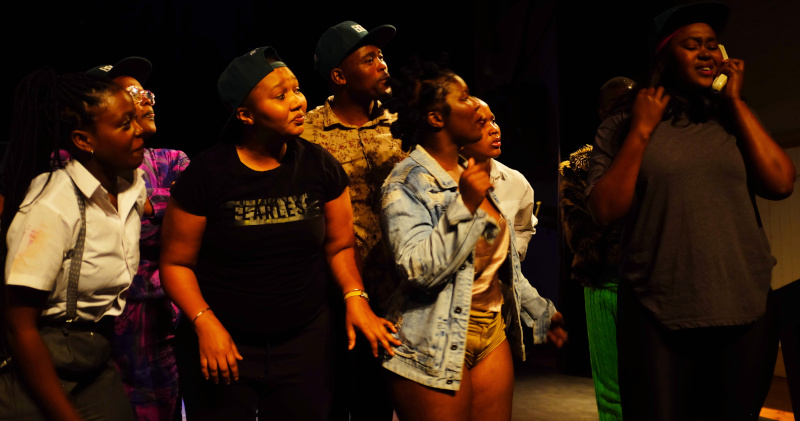
Ghetto The Musical: Chaotic township energy
Let’s get rid of the ghetto
I hope I don’t die for a long time. I still got things I want to do and look at and boys to talk to.
Let’s get rid of the ghetto
I don’t know if I wanna get married but I want to wear Bantu knots if I do and purple lipstick like Bianca Jagger.
Let’s get rid of the ghetto
— Excerpt of monologue read in Ayo Akingbade’s film, Tower XYZ (2016)
Watching Ghetto The Musical on a cold Monday afternoon at St Andrew’s College, I found myself a sad commuter between frustration, anticipation and fatigue. I experienced it as a depressing realistic depiction of poverty and struggle made bearable (or perhaps more crude) by music and dancing. I suspect my feelings were directed towards the content more than the aesthetic and stylistic choices that brought the piece together (we’ll get to that). But first, like filmmaker Ayo Akingbade, I want to get rid of the ghetto because I still got things I want to do and look at and boys to talk to.
One can’t speak of the ghetto without speaking of the conditions that necessitated its creation (racist segregationist policies). And one can’t speak of the ghetto without speaking of conditions that resulted in its continuation — lack of transformation. And so, to speak of the ghetto is inherently political. It is to speak of land.
Based on the lived experiences of the struggling youth in the townships, Ghetto The Musical takes Covid-19 as the main starting point. It speaks to the difficulties of putting food on the table due to lack of work and economic opportunities, of crime and corruption. The 11-piece cast from Eastern Cape Theatre Artists takes us through a dizzying journey of love, hope, fear, violence and redemption in 55 minutes.
Because the piece attempts to touch on so much, a few topics, such as gender based violence, are mentioned in passing and not afforded enough reflection considering their gravity. The sub-narratives are not always coherent — two monologues delivered by chained actors with blood smeared T-shirts while dancers perform a powerful and deeply lyrical sequence leave me feeling confused. Perhaps this incoherence is fitting because ghetto life is bewildering — how can generations of people be expected to survive so much structural violence by the state? And yet we do.
I appreciated the attempt at queering township life through a depiction of queer youth — although at times this ran the risk of being tropey where queerness is articulated with an oversexualisation of the body; our main interaction with queerness is through a sexy rendition of a musical number about justice. For the most part, the piece was successful in its fluid use of language — melding isiXhosa, English and tsotsitaal seamlessly throughout the performance. Monolingual viewers, who might have otherwise struggled to follow, were assisted by the highly gestural and embodied performances which offered a different avenue of communication.
Scholar in Black Studies Dhanveer Singh Brar speaks of “a ghetto ecology that is manufactured in the relations between dance, sound, territory, race, and class”. This reading of the ghetto contextualises how music is integral in storytelling, be it in stories of struggle or joy, something director Luyolo Shaba Sentile understood intuitively. The music carried the performance. With minimal use of props — tyres, crates, a telephone booth, plastic wash basin — and bold choices in costumes, Ghetto The Musical succeeded in painting scenes in our mind’s eye. The energy of the township coursed through the stage, transferring itself into an enthusiastic and thunderous applause as the musical concluded.
Ghetto The Musical will be performed on the 28th Jun (8pm) and 29th Jun (4pm) at St. Andrew’s Hall.