


Looking at men, looking at women
 Any idea of value is almost certainly being developed by more than one person, or group of people, at roughly the same time.
This has regularly proved true in science, and same is true in the arts, of course. The knowledge that true originality is so rare as to be almost non-existent can lead to despair or could be accepted as affirmation of our connectedness as a species. Sort of like those forests where each tree appears to be an individual growth but are connected underground by a unifying rhizome.
It is this connectedness that results in a particular character, or set of issues, emerging among work presented at this concentrated creative gathering here in Grahamstown every year. Yes, there is the element of curation on the Main, but one can pick out certain themes that echo through works on the Fringe as well.
It’s possible NAF artistic director Ismail Mahomed connected the dots between Mamela Nyamza and Nelisiwe Xaba’s The Last Attitude and Tumbuka Contemporary Dance Company’s portrait of myself as my father, particularly as they appear side by side in the programme, but somehow I believe serendipity may have played a role. I must remember to ask him. For both dance works involve women probing masculinity and how it is depicted.
In the context of sustained feminist outrage expressed on social media where misandry is often thinly veiled, that two women independently choose to examine masculinity, and celebrate it, is fascinating. I could be wrong, but I doubt Zimbabwean born and New York-based choreographer Nora Chipaumire and Nyamza and Xaba, who I believe work in Johannesburg, shared ideas.
While concepts of masculinity form the core of their work, concept is where the similarity ends. It’s as if they exited through doors on opposite sides of the same room.
The Last Attitude is mostly silent, highly stylised and controlled (crittered here), while portrait of myself as my father overflows with high energy Chimurenga music and the dances it invokes, reflecting the posing, swagger and pure celebration of masculine agility and strength echoed in other male orientated dance forms such as pantsula.
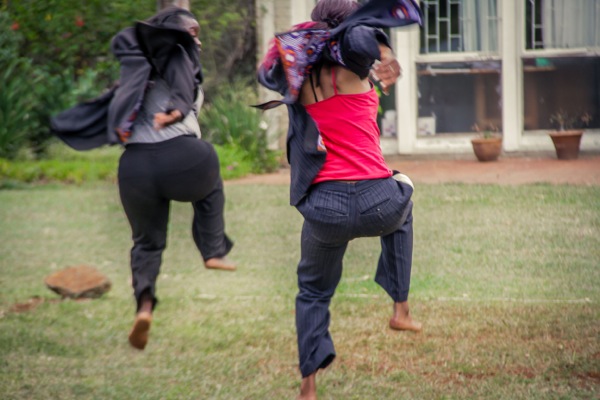
The inclusion of four women split into two pairs while the four male dancers formed an ensemble of their own provides a women’s interpretation of the male pose that underscores the misunderstanding between the genders.Throughout the work, one pair of women (all dancers are dressed similarly in pants and jacket) essentially repeat the strut of out-thrust chest and raised chin. The womens’ mimicked male gaze contains arrogance and borders on the aggressive, but in the men, there is humour in their eyes as they know (although might not admit) their strutting is based on insecurity. As men, their swagger is as much a request for affirmation as a display of virility. The difference in the gaze indicates a chasm of misperception between the sexes, of just how men can be misunderstood. Obviously, it works the other way round too, just not in this piece.
The work is powerful, but often it is merely the power of repetition, which is unnecessary. Fifty minutes could be better used to create progression, which is lacking here. There’s a depth created through repetition, much like African music repeats rhythm, but it might be better served unstaged, the space within which it is presented creates expectations that aren’t met, a dissonance in language.
Additionally, the illuminated square in the red earth upon which they dance served no purpose other than to prevent them from dancing in the middle of the stage. It was superflous and as such, was out of place.
While there is an urgent vibrancy in this rendition of Chipaumire’s work and a wonderous energy in the dance, it was rather like being served a delicious ‘smiley’ in a five-star restaurant. An authentic offering, but served in the wrong setting.
portrait of myself as my father is on the Main, with the last two shows today. Details here.
— Steve Kretzmann