


Peeling Shadows: Make-believe justice
Picture what the world would look like if South Africa was a children’s story. Flat caricatures of our government like the cut-out characters in a picture book. Open the book and see the image of a big mansion where bad things happen but no one has ever been able to bring the culprits to justice.
Peeling Shadows gives us the chance to look at our world through a child’s eyes, a useful device for satire in these tense times. It begins with a little girl holding a teddy bear. She is mute so we see the world in broad strokes as she tries to make sense of the crude experiences she cannot speak back to.
The whole world of Peeling Shadows is set against the backdrop of drawings projected using basic slides, as if from our childhood. It is as though the play wants to take us back into history to solve the mysteries of our present politics. Artfully, it does this by using make-belief, so that what we’re seeing on the stage is our current issues with a magical filter that actually believes in happy endings.
If you can suspend your disbelief in hope, you can immerse yourself in this world to delightful effect. Are you ready to play cops and robbers and believe that justice is possible? If so, now, turn the page and see what lurks behind the image. What is the shadow of this world? Oh, the culprits themselves! Have they created a world of such greed and exploitation of the working class that they’ve turned themselves into two-dimensional figures? It seems so! Haha!
In Peeling Shadows, the shadows that need to be pulled off of our hope for a better world, are the actual culprits themselves. Here, they’ve been magically turned into silhouettes that haunt their own mansion, unable to leave or live as real human beings, because they’ve given up their humanity for the sake of endless and unsatisfying consumption. Greed has caught them in a loop. The three figures who have gotten away with actual murder have been hollowed out by their crimes. They are shadows of who they could have been if they hadn’t been so greedy. But how do we catch shadows?
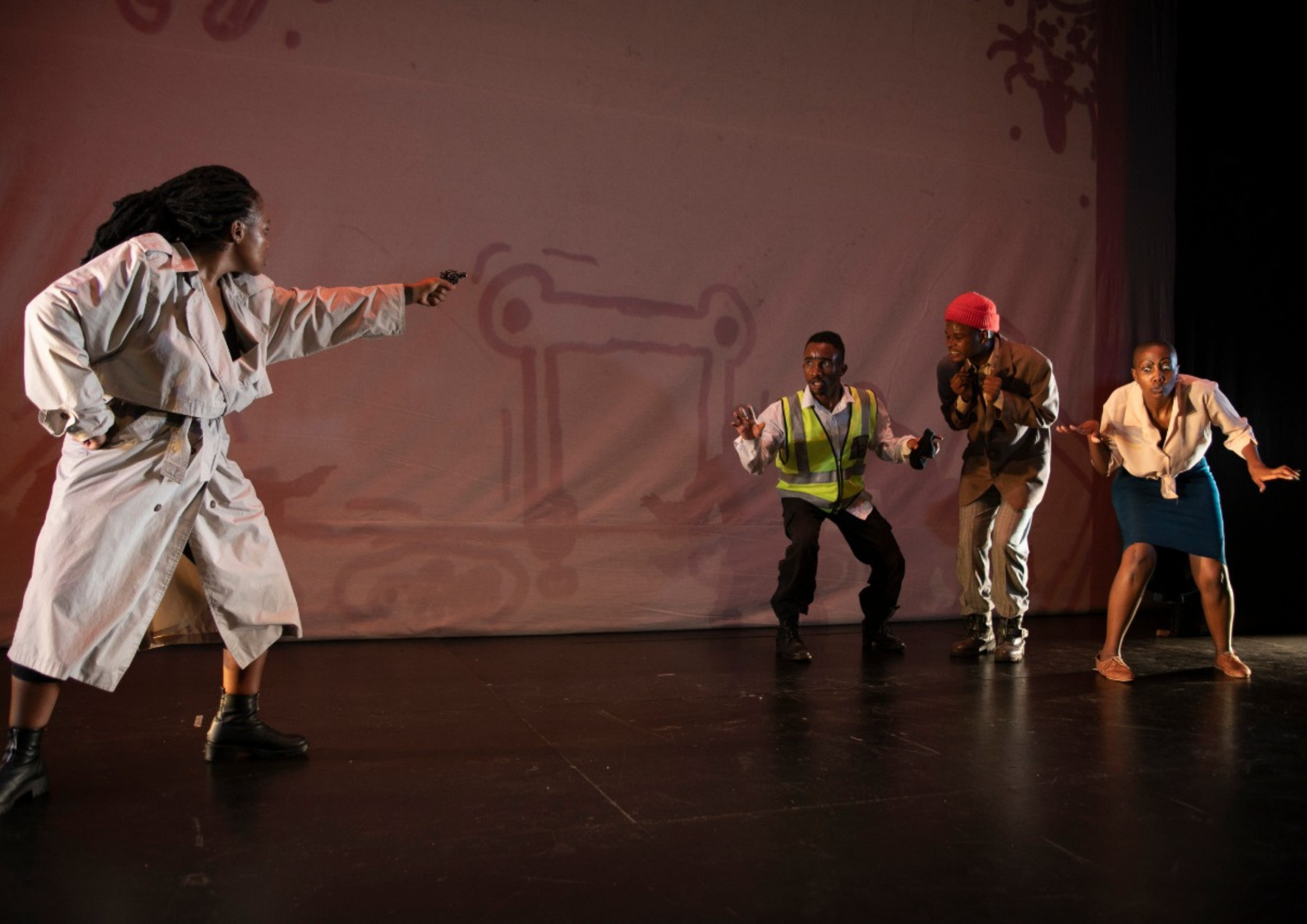
Quickly, turn the page again. Imagine a crabby detective named Pamela Jack coming to solve the mystery. She actually walks like a crab, scuttling across the stage in a classic detective trench-coat. Okay, okay, if it’s hard to imagine Pamela Jack can solve any mysteries because she’s actually just playing at being a detective, you’re right.
As this story starts, Pamela Jack hasn’t been able to crack this case in over six years. She’s the performance of a detective like so many of our actual law-keepers. Tiptoeing in, like the pink Panther in a Sherlock Holmes coat, she asks us to believe that she can catch the criminals who live in the big mansion. “Pamela Vows to Catch Gumede Family”, the headlines say.
If you remember this is all make-believe and we are imagining South Africa as a children’s story, well then, who better to help catch the corrupt family of shadows than our bumbling, crabby anti-hero? Except at the first sign of trouble, she faints. At the first sign of money, she is tempted. “Boozed cops flop again”, the headlines state, scribbled on the overhead slide projector as though the mute child herself is trying to solve our country’s mysteries.
Spoiler alert: she is. It is the child who gets the attention of Pamela Jack and takes her through the streets of the city. The directors (Joël Leonard and Sinenhlanhla Mgeyi) use a joyously simple sliding cityscape across the overhead projector to make us believe Pamela Jack and the child are walking through town. The child is trying to take the detective to the mansion so she can catch the criminals and allow the child to move on from the traumas of the past.
In the crabby detective with a plastic toy gun, we get to see an image of justice in the conventional sense: criminals in handcuffs. But remember we have had to trick ourselves into imagining there are actual handcuffs on the miming hands; we start to think how justice itself can be a trick of the eye. In reality we only shift criminals from view. What happens in Peeling Shadows becomes important then; before the story book closes, the criminals are brought forward from the shadows and become three-dimensional people again.
They do not repent. They are, however, reminded of humanity when the child speaks her story. They are not allowed to simply remain dehumanized and dehumanizing flat figures in shadowy prisons.
Peeling Shadows allows us to see humanity in the flat images of our newspaper headlines. It provides a catharsis for those who need it, gives us a distanced look at the politics of the stomach. The form of children’s theatre provides a rich landscape for cutting to the heart of things in a playful yet political way, yet the directors could refine this potentially significant form into a sharper satirical story. Animal Farm stands as a classic in this form.
The hand of refinement could also be lent to the visual work, in its disarming aesthetic. Cutting out of the moving images could make them pop over the slide laminates instead of the clunky square shapes of transparency over transparency.
However, Peeling Shadows is a delightful trip into the world of make-belief for children and our inner child \, where the imagination can hope for happy endings again.
It is available to watch on the online National Arts Festival’s Main programme until midnight tonight. View it here.
©2021 The Critter. This article is licensed under a Creative Commons Attribution-NoDerivatives 4.0 International License.
Peeling Shadows is devised & performed by: Dintshitile Mashile, Wonder Nhlanhla Ndlovu, Mosehlana Mamaregane, Upile uThixo Bongco and Sboniso Thombeni
Directed by Joel Leonard & Sinenhlanhla Mgeyi
Illustration by Joel Leonard
Musical Composition & Direction by Wonder Nhlanhla Ndlovu & Harry Adu Faulkner
Sound Design by Harry Adu Faulkner
Dramaturgy by Upile uThixo Bongco
Choreography by Sboniso Thombeni
Lighting Design by Sbusiso Ndumndum
Poster Design by Ryan Lloyd & Joel Leonard