


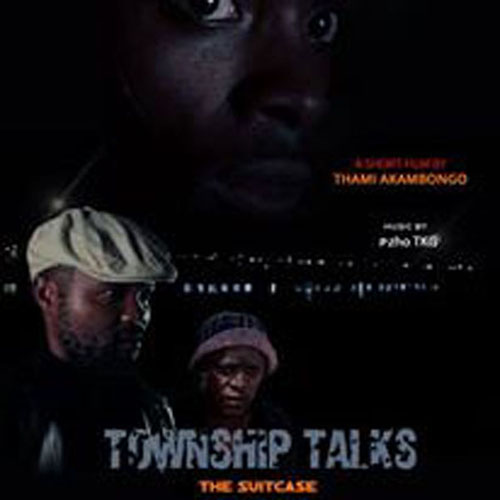
Township Talks: Oversimplification fogs the lens
By Denzel Nyathi
The short film is always a daring venture. Feature length films have the coveted commodity of time to weave their story, the short has no such luxury. Whole worlds are to be created in a fraction of the time one might spend in a cinema. Yet, to their advantage, there is something satisfying about a story that unfolds succinctly and powerfully. In an era of instant gratification, there’s no guarantee that a two hour Russo Brothers blockbuster might pique my interest like a 10 minute YouTube indie film.
In just 15 minute, Thambi Mbongo dares to venture into the busy life and culture of elok’shini (townships) with Township Talks: The Suitcase.
Unfortunately, the reward alludes me with The Suitcase. A short film calls for a certain craft to compensate for the brevity that distinguishes it. Yet, it was in many of the smaller details that the film failed to deliver.
The film enticed me with a story of youth in an unspecified township facing the daily struggles of institutionalised poverty. In their struggle, the call to crime is an overbearing one, almost too easy to respond to. Our hardworking, peanuts-and-sweets-selling, earnest protagonist Tando (played by Bonani Ngamiani), eventually chooses the path of crime. While we’re led to a degree of concern for his safety and ongoing schooling career, I couldn’t find it in me to really dispute his decision. With a sickly grandfather and the double weight of blackness and poverty, it’s an understandable decision.
The opening monologue captures the complexity of the situation as it states: “Yes, we are poor and suffering. But we don’t glorify suffering.” Nothing about the film glamorizes the hardships of the townships through the lens of a distant white gaze (owing to the all black cast and production team). While townships have historically been (and continue to be) the heartbeat of much of South Africa’s social change, to throw City of Gold paint over them and call it beautiful is to erase the lived hardships.
Director of Photography, Lwando Solani, does no such thing. Rather, the B-Roll footage simply captures the hustle of life in an army of school shoes in one scene, and busy traffic in another. Combined with the signature tune which calls to local hip hop music of earlier in this millennium, there’s almost something comforting about the film.
Almost.
The promise to not glorify the setting has a bitter after taste as it becomes clearer by the minute that Mbongo, who is writer and director, over simplifies matters. While a degree of understanding is extended in that there is little time construct intricate storylines, one can’t help notice there’s almost no relationship established between the characters at all. Tando and Mr Qhankqiso (Tando’s gateway to a life of crime) have the lion’s share of on-screen interactions, and yet, even then, the relationship remains one dimensional. Tando is the timid, naïve schoolboy. Mr Qhankqiso is the rich silently scary drug lord, who commands respect. Even when Tando raises valid concerns of being caught out at school as suspicion rises, he dismisses himself and turns to praising Qhankqiso, who “knows best”.
With little time to explore other characters, their depravity is left to the imagination. One fedora-wearing character plays a hilariously ambiguous role – and seems to shoot someone at the end of the film (Note: I say “someone” not to preserve the mystery of the film, but because it is literally unclear. Also, this is not done in a cool, cliff hanger way).
The one thing that seems to define all the relationships is that life is tough. The true antagonist of the film, Tsepo, seems to have no justifiable reason for being so vehemently opposed to Tando and his sickly grandfather. I have no choice but to assume it is because life is tough. The simplicity of that statement is the driving force within the film. I have no choice but to assume that Tando’s grandfather is there for him in the way he is at Tando’s greatest point of crisis because life is tough.
With no other tool to make sense of the film, the final narrated monologue’s challenge to consider why it is that people commit crime seems to be mocking me. After having watched it twice, I can’t help but think a 15 minute film containing such ambiguous relationships can’t afford to have there voice-over narrations. Perhaps more could have been achieved through greater investment in dialogue. Dialogue which would have allowed the actors to show off their own chops a bit more.
In all fairness, I believe we can blame Covid-19 again. Inqwelo Cinema, the one production company (in collaboration with Hashtag Entertainment Production), shared via Facebook in January that there were plans to shoot as many as four other instalments of Township Talks. In March, they posted that the lockdown affected production. Perhaps with more instalments, better sense will be made of The Suitcase. Certainly, cinematic and thematic parallels can be drawn between hit semi-anthology TV series Intersexions and what Township Talks has the potential to be. I maintain hope for the bigger picture.
Township Talks: The Suitcase is on the vNAF Fringe programme. A tickets costs just R25. Watch it here.
Production Credits
Executive Producer: Sabelo Mahlathi
Script-writer: Thami aka Mbongo
Cast: Bonani Ngamlani, Lonwabo Ngcingci, Bandile Mbana, Andile Nodada, Esethu Jende
Director: Thami aka Mbongo
Director of Photography: Lwando Solani
Editor: Luthando Galada
Music & Sound Effect: Pzho
I was such a fan of intersexions and stories that talk about townships life, definitely want to check it out.