


The Rangers: Begging for more bite
It was the second scene in The Rangers that set the tone for the play, although this was likely not the intention of the playwright and director.
After the first scene in which Desmond (Nicholas Pauling), distinctly dressed in woodsman’s gear, exits his cabin with shotgun in hand after having contemplatively chewed on a bloody piece of meat, we see Zakes (Aidan Scott) and Charlie (Lyle October) standing outside the door arguing over whether the cabin might belong to Desmond, whom they’ve travelled from South Africa to snowbound Canada to seek. We only see their heads, thanks to an intentionally undressed part of the cabin wall, the interior of which is exposed to us in all its messy masculinity.
Two talking heads, literally, verbosely quarreling about the cold and the distance they’ve travelled, and whether they’ve stumbled upon their goal. What came to mind was the disembodied heads in Beckett’s Endgame.
It seemed this strangely staged exchange outside the closed door was to expose us to the ornately crass vocabulary employed in their mutual sniping. This would be fine if this was a comedy of the slapstick variety, or a nod to Beckett, which would be a stretch given this was billed, and strained hard to be, a psychological thriller. Which it could be, but for the peppering of such directorial faux pas. Most of what they had to say in this scene – if it really needed to be said at all – could have been said after they’d tried the handle and barged in to stand before us.
The plot is quite straightforward: Zakes, accompanied by long-time friend Charlie, is in search of his older brother who retreated into the Canadian backwoods a decade ago to escape their cruelly perverted parents who were the unrepentant cause of his public humiliation.
Pauling, an accomplished actor, exudes the suitably brooding menace one might expect from a hermit with misanthropic tendencies born of a traumatic past, but with just enough misplaced empathy to send his abandoned little brother an annual birthday card. Young actors Scott and October didn’t seem to have much room to stretch beneath the barrage of verbiage the script has each loosing on the other. The dialogue was overly verbose, which to an audience familiar with Tarantino and is not easily shocked by imaginative cursing, comes across as dark comedy. This ironically undermined the supposed tension between these characters. In fact, that we understood a tension was supposed to exist was probably testament to Scott and October’s acting abilities. With our eyes closed it would have sounded like two pompous film studies undergrads trying to show off their knowledge of the thesaurus while playing drinking games.
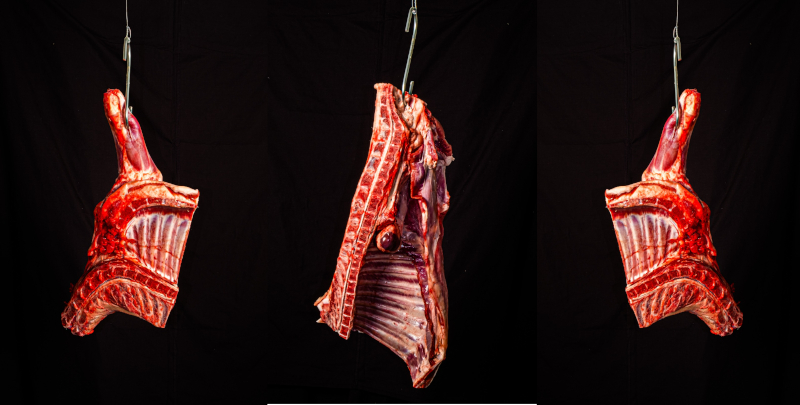
While there is an unspoken agreement to suspend disbelief, the play does have to meet us partway, particularly if it is realist. There are many small things we can happily look past, such as, for example, our travelers arriving at the snowbound cabin sans any luggage. But when too many small things add up, disbelief starts becoming an effort, and begins to fray. The sections of carcass – oddly depicted by photographs within Patrick Curtis’s otherwise convincing depiction of a backwoods cabin interior – hanging in a centrally heated room, the shotgun for hunting big game (a pithy observation missed, given the play’s denoument), exits into the snow sans gloves or jacket, etc.
Still, despite sections of dialogue very near echoing popular movie scenes, the denoument contains some shock value; there were gasps from the bleachers.
There are a lot of metaphorical babies to be killed, and if playwright and director Daniel Newton can do that, and give the actors room to breath, The Rangers may yet become a debut to be proud of.
The Rangers plays at the Masambe Theatre in the Baxter precinct until 1 April. Times and bookings here.