


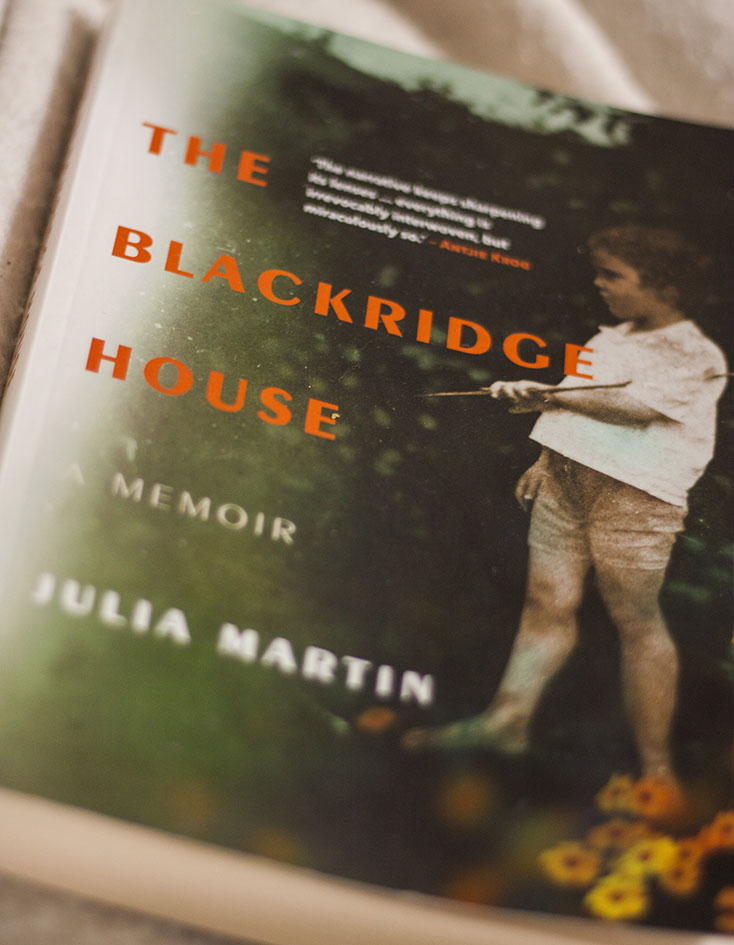
The Blackridge House: Laying memory to rest
This is a book about death, and about dying. As much a meditation as a story. Not morbid though. For death to occur, there must have been a life, and it is life that fills the pages of The Blackridge House. The life of Julia Martins’s mother, as well as the people who made it possible for her, and made it possible for the author, as well as the circumstances that lead to particular people being in a particular place at a particular time. It is also a quest, which is how the story continues, and a memoir of that quest, which is a word that conjures ideas of dragons, horses, swords and swarthy characters. There are not many of those, and only one swarthy character, who is a librarian. This a gentle quest, its departure a nursing home, one from which the room has a view of a syringa tree and the squirrels that scurrel along its branches. It involves family, old photographs, and assistance from genteel strangers, such as librarians and retiring civil servants in the urban planning bureau. It is about understanding, coming-to-terms, awareness, which is what a good quest should achieve.
Julia is looking for a lost home, one that belonged to her mother, who is old and dying and suffering short term memory loss. Thus The Blackridge House is also an ode to her. It is a slow read. It is also absorbing, and poetic; the gossamer threads of relationships based on natural curiosity, the small heroisms born of the inexplicable desire of strangers to assist swell in poignancy for actually haven taken place.
Although the quest is personal, internal and with no aim or prospect of achieving any effect beyond that of discovering the genesis of a parent’s memories and laying a second-hand nostalgia to rest, the sweep of history is found in the particular; a sincere attempt to understand a place involves consideration of the many who have inhabited it during the preceding aeons – its plants, its animals, its people.
Being sincere, and not without a wry sense of humour, Julia journeys beyond the previous generation, unearths deeper layers that consider history and conquest and inheritance. Her memoir, is also a work of psychospatiality – the intertwining influence between landscape and people; how the natural world bears on the psychology of the people who inhabit it, and in the context of the industrial age’s accelerated movement of people, includes the baggage they bring along from other landscapes and the societies they have moulded, and how this baggage of the psyche is repurposed or possibly abandoned in a new reality.
It comes about, this psychospatiality (for the term psychogeography is too rooted in the urban environment) effortlessly, through observation and empathy rather than deliberate focus. Mention is made, for instance, of the railway line, symbol and achievement of empire, a catalyst for industry, property ownership, the progression of engineering and civilisation, now torn up and abandoned, the contour returned to the dominion of grasses and flowers, beetles, rodents, and birds. A place cattle graze once more, but no longer quite as they used to; history’s full weight bears on the present.
Like a cartographer who is able to decode contours, lines, shadow and light to create a three dimensional vision of kloofs, peaks, vegetation density and type, rock strata and watercourses, Julia uses her intuition and intelligence to provide a nuanced view of the struggles, achievements, the hard-fought conquests over land and people and nature that provide a moment untrammeled in the sun, as well as the sorrow, dislocation, and violence these misguided ill-conceived struggles wield even as joy was to be had in the fight. In this sense, Julia Martins’s book on the dying of her mother and her memories straddles the description of memoir and novel, for it is also an epic journey across the bloodstained soil of Africa in the south, all of which blows through its homes.
Julia Martin is a professor in the Department of English at the University of the Western Cape.