


History enriches the future at Sophie Mgcina Award evening
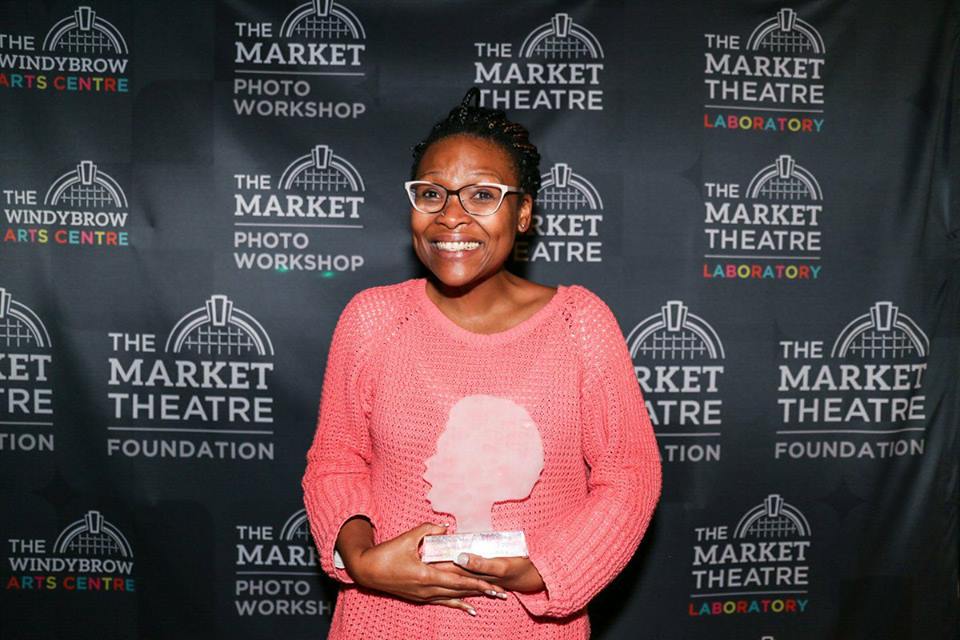
And the winner of this year’s Sophie Mgcina Emerging Voice Award is… Lesedi Job.
Accepting her award on the Market Theatre’s John Kani stage last night, the Wits Honours graduate broke into song thanking her mother.
Having performed onstage as part of ensemble production showcasing the tremendous talent in the Market Theatre incubator programme less than an hour before the award announcement, Job thanked the “single black woman” who “made me the person I am today”.
It was the first time in the four-year-existence of the award that it was presented at the Market Theatre, at the culmination of an evening rich in legacy and future promise. The award was previously presented at the Naledi Awards evening.
Legacy was symbolically represented by the awards being presented on the 41st birthday of the Market Theatre itself, an institution that was the centrepoint of anti-apartheid protest theatre and the development of new talent. Additionally, Living Legends Letta Mbulu and Caiphus Semenya were present. The duo shared the microphone in providing a humurous, unprepared tribute to the Sophie Mgcina they both knew and worked with, while the late Sophie’s daughter and only child, Ali Tsindwa fought to hold back her tears.
Semenya, who dropped a couple of broad hints that he knew Sophie better, in certain ways, than anyone in the room, said although they grew up on the same street in Alexandra, they only really met each other when they both worked on King Kong – The Musical.
Mbulu, who laughingly commented that Semenya’s recollections were “a bit awkward”, recalled meeting Sophie in 1957 when they were both competing in the South African Union of Artists’ talent competition. While Mbulu was a regional winner from Orlando East, Sophie was the winner from George Goch. Mbulu described hearing Sophie sing a popular radio song of the time, called Diana.
“But when she opened her mouth, I was shocked, because she didn’t sing it in English. She put her own spirit into the song. She sang it in isiZulu.
“If there was one woman in South Africa who understood jazz, it was Sophie,” added Semenya, “she was something else.”
Returning to the award in Sophie’s honour, Mbulu said it was “the best thing that has ever happened to South African artists”.
“We were never given these important, important spaces.”
As award winner, Job gets the opportunity to direct a full production on a Market Theatre stage, said Market Theatre Foundation CEO Ismail Mohamed.
The future promise contained at the John Kani Theatre, was the event also being the official launch of the inaugural Arts Incubator’s Trade Fair taking place at the Market Theatre precinct this week.
The Trade Fair is the first time the six state-funded performing arts institutions of Artscape, Performing Arts Centre of the Free State (Pacofs), SA State Theatre, Durban Playhouse, Market Theatre and Windybrow Arts Centre have ever got together to share ideas, experiences and showcase the talent developed under the Department of Arts and Culture (DAC) Incubator Fund.
DAC director-general Vusithemba Ndima, who had watched eight of the Market Theatre’s incubatees raise the audience to their feet with a mixture of song, dance and monologue centred around the pain of dispossesion and inequality, pierced with flashes of bittersweet humour, said there were moments he had to hold back his tears.
“Sometimes I felt I was almost in a therapy session,” said the D-G whose department had provided R1.2m in funding for the inaugural Trade Fair. “I could feel the difficulties of the day falling away from me.”
The Trade Fair, which formed a “collective think tank” and was “a path-breaking exercise at an artistic level”, was all about sharing best practice and identifying areas of collaboration, said Ndima.
The last speaker at the rousing event, Market Theatre Council chair Kwanele Gumbi, did not shy from politics.
While thanking Ndima for his department’s support, he said what he really wanted to see was DAC officials watching productions and seeing what South Africa’s artists were doing.
And artists, said Gumbi, needed to challenge the state, which he made clear he believed was in dire straits.
Speaking without a script, he urged artists to “not let things get any worse than they already are”.
“Do not be passive, or you will have no country left. You’ll have democracy but you will be enslaved in that democracy.”
With June 16 still fresh in the country’s mind, Gumbi received the youths’ finger-clicking approval as he said: “You thought ‘76 was political? Smell the coffee! It’s more political now.”
“That was the best chairperson’s speech I’ve ever heard,” said Mannie Manim, who co-founded the Market Theatre with Barney Simon in 1976.